

Olympic gold medals are the currency of sporting legacy — the performances that nations remember across generations, that inspire the athletes who follow, and that permanently alter how a country understands its own competitive potential. India’s relationship with Olympic gold has been defined by extraordinary historical achievement in hockey alongside a painful drought in individual events that made each subsequent gold feel like a release of decades of accumulated sporting ambition. Understanding india gold medal history requires engaging with both the glory and the long wait that makes each achievement resonate so deeply. Fans following Indian sport and Olympic competition can find dedicated markets at dbbet apk.
The Foundation: India’s Olympic Identity
India’s Olympic journey began at the 1900 Paris Games — the second modern Olympics — where Norman Pritchard won two silver medals in athletics, representing British India in the sport’s earliest international competitive framework. The transition from colonial participation to independent national Olympic representation from 1948 onward gave Olympic achievement a specific national identity significance that sporting results in other contexts could not carry.
The specific tension that has defined India’s Olympic gold medal history — extraordinary collective success in hockey across the sport’s early Olympic decades, followed by a prolonged absence of gold in individual events — reflects both the genuine greatness of India’s hockey tradition and the specific organizational and developmental challenges that converting the country’s enormous athletic talent into individual Olympic gold has historically required.
Hockey’s Golden Era: Eight Olympic Golds
The foundation of india’s gold medal in olympics history was built entirely on field hockey — a sport in which the Indian men’s team achieved a dominance across the Olympic program that stands as one of international sport’s most sustained periods of national excellence across any discipline.
India won Olympic hockey gold in 1928, 1932, 1936, 1948, 1952, 1956, 1960, and 1968 — eight gold medals across ten Olympic appearances in a run of dominance whose statistical record no other nation in any team sport has equaled across the modern Olympic era. The teams of Dhyan Chand — whose goal-scoring instinct and stick skills generated comparisons to supernatural ability from opponents and administrators who struggled to explain his performances through purely technical frameworks — represented hockey excellence so comprehensive that opposing nations spent decades attempting to develop approaches that could interrupt India’s continuous championship sequence.
The specific characteristics that made Indian hockey so dominant during this era — the technical mastery developed through continuous ball contact that the traditional Indian stick-handling style enabled, the physical conditioning appropriate to the playing surfaces of that era, and the depth of talent that the subcontinent’s enormous hockey participation base provided — created conditions where individual excellence was backed by squad depth whose quality opposing nations simply could not match.
The Individual Gold Drought and Its Cultural Weight
India’s last hockey gold in 1980 Moscow coincided with the beginning of a prolonged absence of any Olympic gold — individual or team — that extended across 28 years until Beijing 2008. This period carried specific cultural weight within Indian sport that pure sports analysis cannot fully capture — the growing disconnect between the country’s enormous population, passionate sporting culture, and the Olympic medal table position that demographic potential theoretically justified.
The specific factors contributing to this drought were organizational and developmental rather than reflecting absence of athletic talent. Coaching infrastructure at international-standard level was limited. Sports science support that modern Olympic preparation requires was largely unavailable within India. The economic pressures that caused talented athletes to prioritize employment over sporting development at precisely the career stage where full-time training commitment is most critical consistently depleted the talent pipeline of performers who could have developed into Olympic medal contenders with appropriate support.
Abhinav Bindra: The Individual Gold That Changed Everything
The moment that ended India’s individual Olympic gold drought arrived in Beijing on August 11, 2008 — Abhinav Bindra’s 10 meter air rifle gold medal delivering gold medal in olympics by india in an individual event for the first time in the nation’s entire Olympic history.
Bindra’s achievement was not a chance performance but the product of an extraordinarily disciplined preparation process — the investment of personal resources, international coaching partnerships, purpose-built training infrastructure in his family home, and the specific psychological preparation that individual shooting at Olympic level demands. His approach to Olympic preparation was more sophisticated than Indian sports institutions could provide at the time, reflecting a self-funded individual commitment that the result validated completely.
The gold’s significance extended far beyond shooting into how India understood its Olympic potential. If a young man from Chandigarh could win individual Olympic gold through appropriate preparation — overcoming the organizational limitations that Indian sport presented in 2008 through personal resourcefulness and international expertise — then the constraint on Indian Olympic achievement was developmental rather than genetic. The talent existed. The system needed to develop around it.
Neeraj Chopra: The Athletic Gold That Completed the Picture
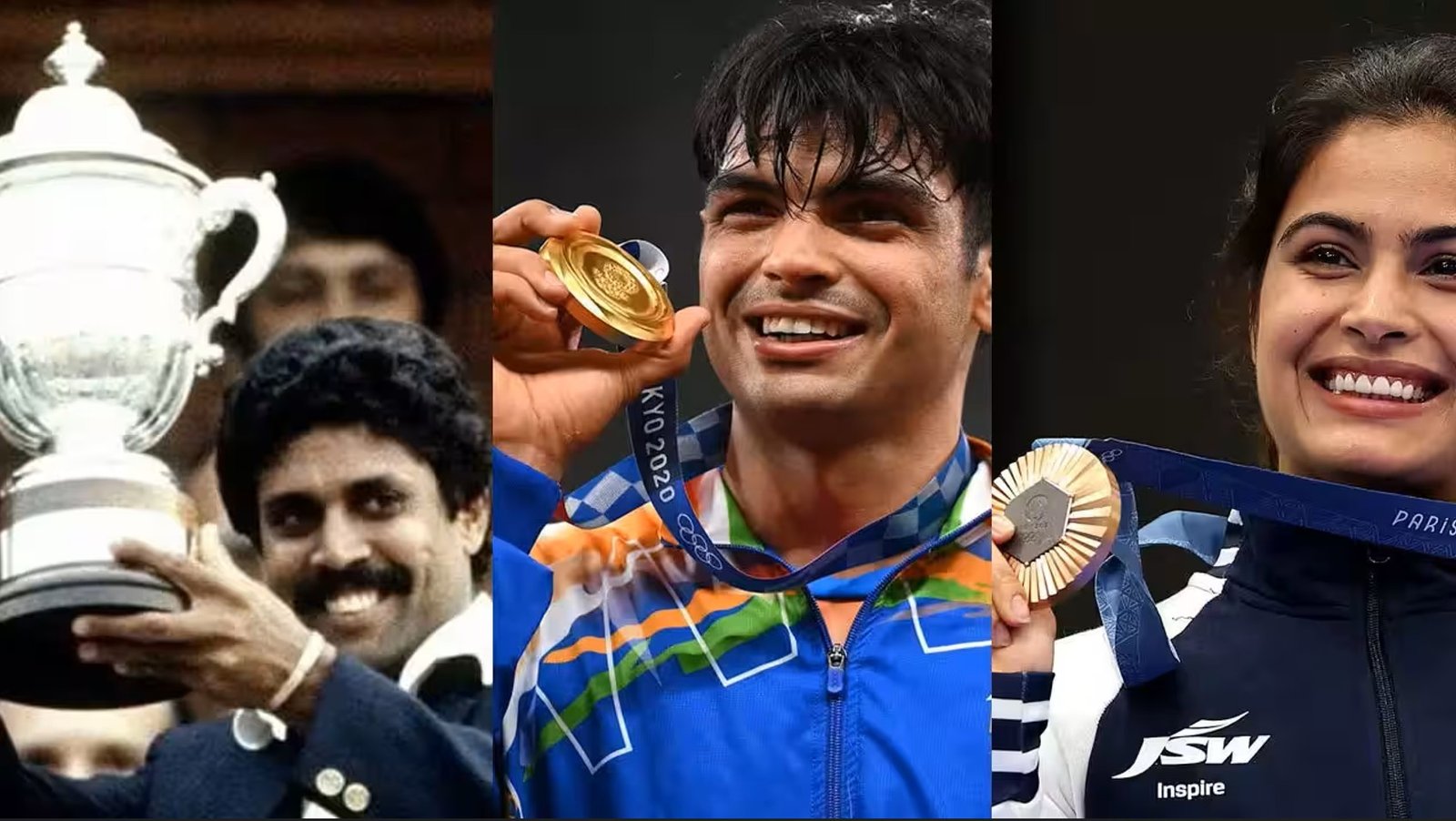
If Bindra’s gold opened the conversation about individual Indian Olympic excellence, Neeraj Chopra’s javelin gold in Tokyo 2021 completed a specific chapter — delivering the first Olympic gold in athletics, the Olympic program’s most central discipline, that India had been working toward across decades of athletic development.
Chopra’s 87.58 meter throw in his opening attempt — establishing a leading mark that held through the entire competition — was produced with the quiet certainty of an athlete whose preparation had been genuinely comprehensive rather than optimistically hopeful. His development through the Army Sports Institute, his coaching partnership with international javelin specialists, and the specific support of the Target Olympic Podium Scheme collectively reflected how Indian sports institutions had developed across the decade since Bindra’s pioneering gold.
The celebration that followed was India-wide and genuine — reflecting both the athletic achievement and the specific symbolism of winning in athletics, the discipline where Olympic competition is most fundamentally expressed and where India’s previous gold medal absence had been most conspicuous. Schools named after Chopra, streets renamed in his honor, and the measurable increase in youth participation in throwing events across the country demonstrated the inspiration effect that resonates most practically into the country’s athletic future.
Wrestling, Badminton, and the Growing Medal Ecosystem
India’s Olympic gold medal story is not confined to Bindra and Chopra — the broader medal-winning ecosystem that has developed across wrestling, badminton, shooting, and boxing reflects systematic improvement in multiple disciplines simultaneously rather than isolated individual excellence.
While wrestling has produced consistent Olympic medals across recent Games — Sushil Kumar’s historic back-to-back medals in 2008 and 2012, Bajrang Punia’s bronze in Tokyo — the gold that the discipline’s competitive quality has suggested is achievable has remained elusive, representing the next frontier rather than established achievement. Badminton’s PV Sindhu has won consecutive Olympic medals including a gold in Tokyo — a performance whose significance for women’s sport in India extends beyond the medal into how female athletic ambition is perceived across communities whose cultural frameworks had previously constrained it.
The TOPS Scheme: Building Gold Medal Infrastructure
The Target Olympic Podium Scheme — India’s governmental program identifying athletes with realistic Olympic medal potential and providing customized support including international competition exposure, specialized coaching, and financial assistance — represents the most significant institutional response to the organizational failures that the individual gold drought reflected.
TOPS’s impact is measurable in the progressive improvement in India’s Olympic results across successive Games — from Beijing 2008’s single gold through London 2012’s six medals, Rio 2016’s two medals, and Tokyo 2020’s seven-medal haul that represented the country’s best Olympic performance. The scheme’s identification process — bringing sports science assessment and competitive history analysis to bear on realistic medal probability — directs resources toward athletes whose development trajectory supports genuine podium expectations rather than distributing support too broadly to generate optimal returns.
What India’s Gold Medal Future Requires
India’s Olympic gold medal trajectory across the 2028 Los Angeles and 2032 Brisbane Games will reflect the developmental investments that the current cycle is making — the Khelo India program’s grassroots infrastructure, the TOPS scheme’s elite support, and the progressive improvement in coaching quality across disciplines whose combined effect will only fully manifest in competition results across the next decade.
The specific disciplines where gold medal ambition is most credibly supported — athletics through Chopra’s continued excellence and the generation his success has inspired, wrestling whose competitive depth suggests gold is genuinely achievable, badminton where Sindhu’s Tokyo gold demonstrated the standard is reachable, and shooting whose development pipeline has consistently produced international-level performers — collectively represent a broader gold medal platform than any previous generation of Indian Olympic athletes has been able to build upon.
The cultural significance of each gold medal India wins at future Olympics will compound across this foundation — each achievement inspiring the next generation’s ambition with the specific evidence that preparation and institutional support can deliver results that the country’s talent has always been capable of producing.
